
Cognitive Behavioral Therapy (CBT): How It Works and What to Expect
Cognitive Behavioral Therapy (CBT) is one of the most widely used and researched forms of psychotherapy. It helps people understand the connection between their thoughts, feelings, and behaviors and develop healthier ways of responding to difficult situations.
If you are considering therapy for anxiety, depression, stress, panic attacks, OCD, or other emotional difficulties, you may be wondering what CBT actually involves, how effective it is, and what you can expect during a session.
This guide explains how Cognitive Behavioral Therapy works, what happens during CBT sessions, how long treatment may take, and whether CBT could be right for you.
What Is Cognitive Behavioral Therapy?
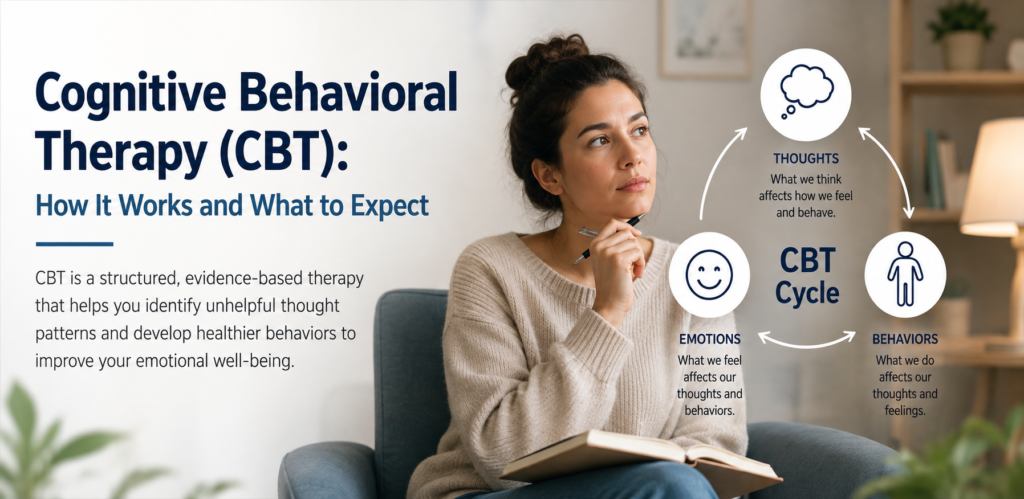
Cognitive Behavioral Therapy (CBT) is a structured, goal-oriented form of psychotherapy that focuses on identifying and changing unhelpful patterns of thinking and behavior.
The basic idea behind CBT is that our thoughts, emotions, physical sensations, and behaviors are connected. When we repeatedly interpret situations in negative or unhelpful ways, these thoughts can influence how we feel and how we respond.
For example, someone experiencing social anxiety might think:
“Everyone will notice that I am nervous.”
This thought may increase anxiety, leading the person to avoid social situations. Avoidance can provide temporary relief but may reinforce the belief that social situations are dangerous or overwhelming.
CBT works by helping individuals:
- Identify unhelpful or distorted thought patterns
- Examine whether their thoughts are accurate and realistic
- Develop healthier and more balanced ways of thinking
- Change behaviors that maintain emotional difficulties
- Learn practical coping strategies
- Gradually face situations they may have been avoiding
- Build skills they can continue using after therapy ends
Unlike some forms of therapy that primarily focus on exploring the past, CBT often focuses on current difficulties and practical strategies for creating change.
The Science Behind CBT — How Thoughts Shape Feelings and Behavior
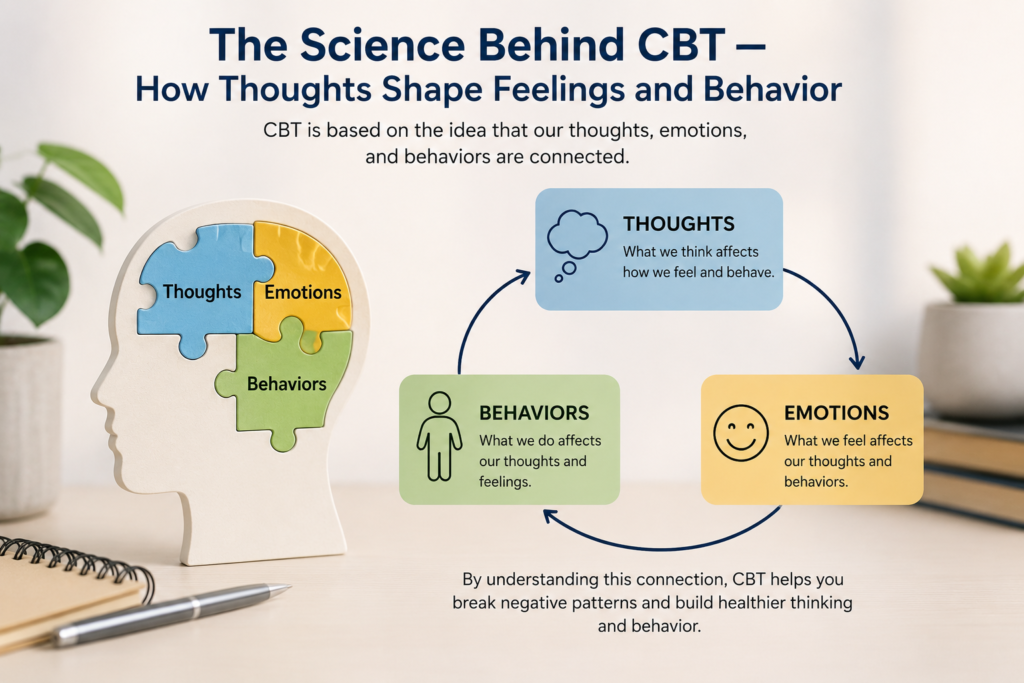
One of the central principles of CBT is that the way we interpret an event can influence our emotional and behavioral response.
Consider this example:
Situation: You send an important message to someone and receive no response.
Thought: “They must be angry with me.”
Feeling: Anxiety, sadness, or worry.
Behavior: You repeatedly check your phone or send additional messages.
The situation itself has not changed, but the interpretation of the situation can influence how you feel and behave.
CBT helps you examine this process and ask questions such as:
- What evidence supports this thought?
- Is there another possible explanation?
- Am I assuming I know what someone else is thinking?
- Am I focusing only on the negative?
- What would I say to a friend experiencing the same situation?
This process can help people develop more balanced interpretations and respond to situations more effectively.
Common Unhelpful Thinking Patterns
CBT may address patterns such as:
- All-or-nothing thinking: Seeing situations as completely successful or completely unsuccessful.
- Catastrophizing: Expecting the worst possible outcome.
- Mind reading: Assuming you know what another person is thinking.
- Overgeneralization: Drawing broad conclusions from one negative experience.
- Negative filtering: Focusing heavily on negative information while overlooking positive evidence.
- Should statements: Setting rigid expectations about how you or others “should” behave.
- Personalization: Automatically blaming yourself for events that may not be your responsibility.
The goal of CBT is not to force positive thinking. Instead, it encourages realistic, flexible, and evidence-based thinking.
What Conditions Can CBT Treat?
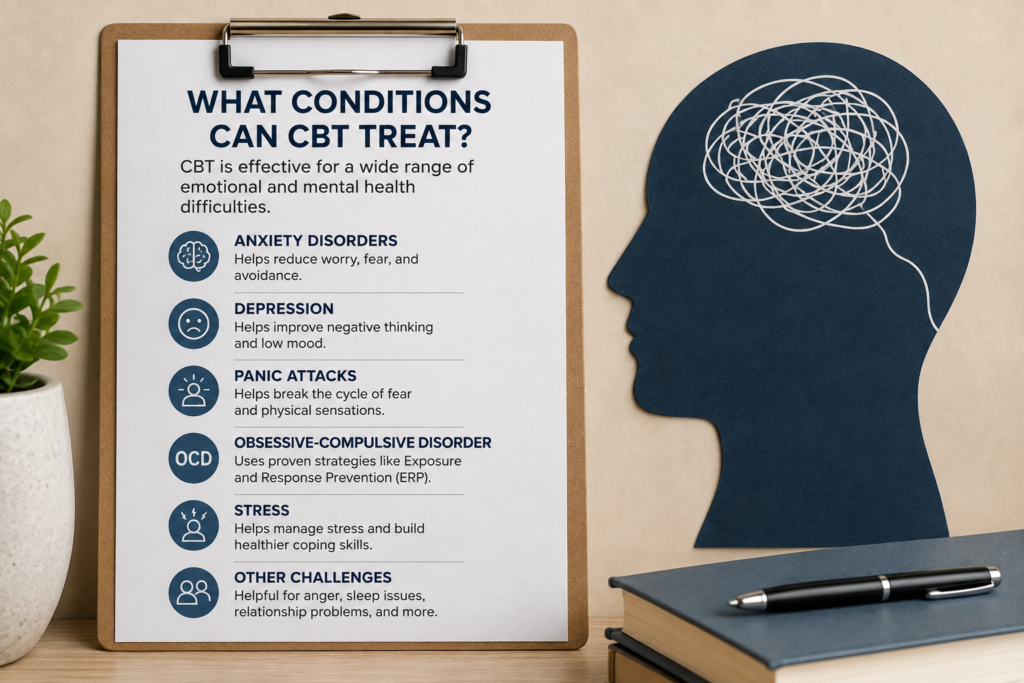
CBT is commonly used to help manage a wide range of psychological and emotional difficulties.
It may be particularly helpful for:
Anxiety Disorders
CBT can help people understand anxious thoughts, reduce avoidance, and develop healthier responses to situations that trigger anxiety.
It may be used for conditions such as:
- Generalized anxiety disorder
- Social anxiety
- Panic disorder
- Specific phobias
- Health anxiety
Depression
CBT for depression often focuses on negative thinking patterns, withdrawal, low motivation, and behaviors that can maintain depressive symptoms.
Therapy may help individuals gradually re-engage with meaningful activities while developing more balanced ways of thinking.
Obsessive-Compulsive Disorder (OCD)
CBT, particularly Exposure and Response Prevention (ERP), is an important psychological treatment for OCD.
It can help individuals gradually face anxiety-provoking thoughts or situations while learning not to rely on compulsive behaviors to reduce anxiety.
Panic Attacks
CBT can help people understand the relationship between physical sensations, catastrophic interpretations, fear, and avoidance.
Learning to interpret bodily sensations differently can reduce the fear cycle associated with panic.
Stress and Other Emotional Difficulties
CBT techniques may also be useful for managing stress, low self-esteem, anger, relationship difficulties, sleep-related problems, and other challenges depending on the individual’s circumstances.
A qualified mental health professional can determine whether CBT is appropriate based on your symptoms, goals, and needs.
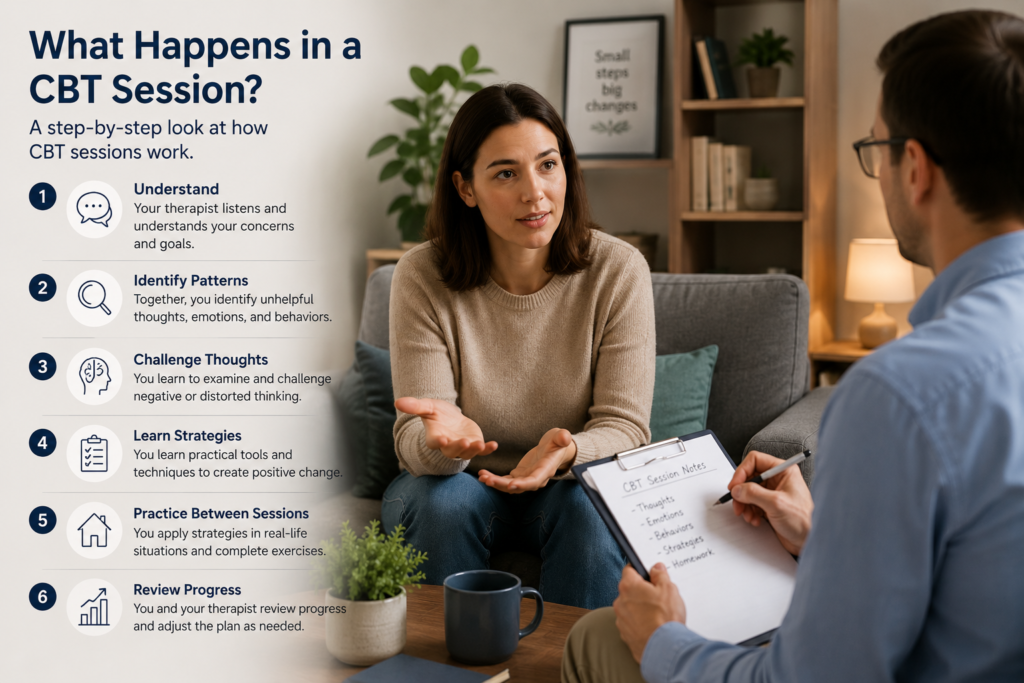
What Happens in a CBT Session? A Step-by-Step Walkthrough
One reason people hesitate to start therapy is that they do not know what will happen during their first appointment.
While every person’s treatment is different, CBT is generally structured and collaborative.
1. Initial Assessment
The first session often involves discussing what brought you to therapy, your current difficulties, relevant background information, and what you would like to change.
Your therapist may ask questions about:
- Your symptoms
- When the problem started
- Situations that trigger difficulties
- Your thoughts and emotions
- Your behaviors and coping strategies
- How the problem affects daily life
- Your goals for therapy
The purpose is to develop a clearer understanding of the problem and establish appropriate treatment goals.
2. Identifying Patterns
Your therapist may help you identify connections between situations, thoughts, emotions, physical sensations, and behaviors.
For example:
Situation → Thought → Emotion → Behavior
Recognizing these patterns can help you understand what may be contributing to your difficulties.
3. Challenging Unhelpful Thoughts
Once problematic thinking patterns are identified, CBT may involve examining and questioning them.
You may learn to distinguish between:
- Facts and assumptions
- Possibilities and probabilities
- Helpful concerns and excessive worry
- Realistic risks and catastrophic predictions
The goal is to develop a more balanced perspective.
4. Learning Behavioral Strategies
CBT is not only about changing thoughts.
Your therapist may also introduce behavioral techniques such as:
- Behavioral activation
- Exposure exercises
- Relaxation techniques
- Problem-solving
- Activity scheduling
- Assertiveness training
- Sleep-related behavioral strategies
The specific techniques depend on your concerns and treatment goals.
5. Practicing Between Sessions
CBT often includes exercises or “homework” between therapy sessions.
This might involve:
- Monitoring thoughts
- Practicing a coping technique
- Completing a thought record
- Gradually facing an avoided situation
- Scheduling meaningful activities
- Practicing new behavioral responses
These activities help you apply what you learn in therapy to everyday situations.
6. Reviewing Progress
At subsequent sessions, you and your therapist can review what worked, what was difficult, and what needs to be adjusted.
This makes CBT a collaborative process rather than a one-size-fits-all treatment.
How Long Does CBT Take to Show Results?
There is no single timeline for CBT because treatment depends on the person’s condition, severity of symptoms, goals, consistency, and individual circumstances.
Some people notice improvements relatively early, while others require a longer course of treatment.
CBT is often delivered over a structured course of sessions, with progress reviewed throughout treatment.
Importantly, improvement does not necessarily mean that every symptom disappears immediately. Therapy often involves gradually developing better coping skills, reducing unhelpful behaviors, and becoming more confident in managing difficult thoughts and emotions.
Your therapist can discuss a more realistic treatment timeline after understanding your specific concerns.
CBT Compared to Other Therapy Approaches
CBT is one of several evidence-based approaches to psychotherapy. Different approaches may be appropriate for different individuals and concerns.
| Therapy Approach | Main Focus |
| CBT | Thoughts, emotions, behaviors, and current patterns |
| ACT | Psychological flexibility, acceptance, and values-based action |
| DBT | Emotional regulation, distress tolerance, interpersonal skills, and mindfulness |
| Psychodynamic Therapy | Emotional patterns, relationships, and experiences that may influence current functioning |
| Supportive Therapy | Emotional support, coping, adjustment, and problem-solving |
These approaches are not necessarily competing treatments. A mental health professional may use techniques from different therapeutic frameworks depending on the person’s needs.
The most appropriate approach depends on your symptoms, goals, preferences, and clinical assessment.
Is CBT Right for You?
CBT may be worth considering if you want a structured and practical approach to managing emotional or behavioral difficulties.
It may be particularly suitable if you want to:
- Understand why certain thoughts keep recurring
- Reduce anxiety or excessive worry
- Manage depressive thinking patterns
- Change behaviors that are affecting your wellbeing
- Overcome avoidance
- Develop practical coping skills
- Work toward specific therapy goals
- Learn techniques you can continue using independently
However, CBT is not automatically the best choice for everyone. A psychologist or other qualified mental health professional can assess your concerns and recommend an appropriate treatment approach.
If you are unsure whether CBT is suitable for you, an initial consultation can be a useful place to start.
Frequently Asked Questions
Is CBT effective?
CBT is a well-established psychological treatment with substantial research supporting its use for several mental health conditions, including anxiety and depression. Its effectiveness can vary depending on the individual, condition, treatment goals, and engagement with therapy.
Is CBT suitable for anxiety?
Yes. CBT is commonly used for anxiety-related difficulties. It can help individuals identify anxious thought patterns, reduce avoidance, develop coping strategies, and gradually change how they respond to anxiety-provoking situations.
Can CBT help with depression?
CBT can be used to treat depression. Treatment may focus on negative thinking patterns, withdrawal from activities, low motivation, and behavioral patterns that can maintain depressive symptoms.
What happens during the first CBT session?
The first session generally involves an assessment and discussion of your main concerns, relevant background, goals, and current difficulties. Your therapist may begin identifying patterns that could be addressed during treatment.
Do I have to talk about my childhood during CBT?
Not necessarily. CBT generally focuses heavily on current thoughts, emotions, behaviors, and difficulties. However, relevant past experiences may be discussed when they help your therapist understand current patterns.
Is CBT only about positive thinking?
No. CBT is not about pretending that everything is positive. Instead, it focuses on identifying inaccurate, unhelpful, or overly negative thinking patterns and developing more balanced and realistic perspectives.
Does CBT require homework?
Many CBT treatments include exercises between sessions. These may help you practice the skills discussed during therapy and apply them to real-life situations.
How many CBT sessions will I need?
The number of sessions varies from person to person. It depends on the nature and severity of the problem, your treatment goals, progress, and clinical needs.
Can CBT be done online?
CBT can be delivered through online therapy or video-based sessions in appropriate circumstances. Your psychologist can help determine whether online CBT is suitable for your situation.
What should I do if I think I need CBT?
If you are experiencing persistent anxiety, depression, excessive worry, panic, OCD symptoms, stress, or other emotional difficulties, consider speaking with a qualified mental health professional.
A psychologist can assess your concerns and help determine whether CBT or another therapeutic approach is appropriate for you.
Take the Next Step Toward Better Mental Health
Starting therapy can feel uncertain, especially when you do not know what to expect. CBT provides a structured approach that can help you understand the relationship between your thoughts, emotions, and behaviors while developing practical skills for managing psychological difficulties.
If you are considering CBT for anxiety, depression, stress, panic attacks, OCD, or other concerns, a professional assessment can help you understand your options and create a treatment plan based on your individual needs.
Book a consultation with a qualified psychologist to discuss your concerns and find out whether Cognitive Behavioral Therapy may be right for you.
Take the Next Step Toward Better Mental Health
Starting therapy can feel uncertain, especially when you are not sure what to expect. Cognitive Behavioral Therapy (CBT) provides a structured and practical approach to understanding the connection between your thoughts, emotions, and behaviors and developing healthier ways to cope with psychological difficulties.
If you are struggling with anxiety, depression, panic attacks, OCD, stress, overthinking, or other emotional concerns, professional support can help you better understand what you are experiencing and identify effective ways to manage it.
Consult Dr. Noman Ramzan
If you are considering CBT and would like professional guidance, you can consult Dr. Noman Ramzan, Clinical Psychologist, for an assessment and personalized treatment recommendations.
Dr. Noman Ramzan provides psychological support for concerns including anxiety, depression, stress, sleep difficulties, OCD, relationship concerns, and other mental health challenges. Based on your individual needs, he can help determine whether CBT or another therapeutic approach may be appropriate for you.
Book a consultation with Dr. Noman Ramzan today and take the first step toward better mental health.